2. Conceptual Foundations
2.1. The European Interoperability Reference Architecture, EIRA©
The European Interoperability Reference Architecture (EIRA©) is a four-view reference architecture designed to deliver interoperable digital public services across borders and sectors in the European Union. It serves as a comprehensive framework that defines the required capabilities for promoting interoperability through a structured set of Architecture Building Blocks (ABBs).
EIRA© provides a blueprint with recommended best practices, standards, and guidelines for designing and implementing systems that are efficient, scalable, and interoperable. It operates as a technology and product-neutral, service-oriented architecture (SOA) that uses ArchiMate® as its modelling notation.
2.2. The eGovernment European Reference Architecture, eGovERA©
The eGovernment European Reference Architecture (eGovERA) provides further granularity and domain focus extension of the European Interoperability Reference Architecture. Whilst EIRA establishes a foundational vocabulary of Architecture Building Blocks at the meta-concept level (level 1 granularity), eGovERA delivers level 2 and further granularity by expanding these building blocks into detailed architecture patterns and implementation guidance. This hierarchical relationship ensures that eGovERA maintains full alignment with EIRA’s core principles and structure whilst offering the additional specificity required for practical solution design and implementation.
2.3. Purposes of EIRA and eGovERA
The European Interoperability Reference Architecture (EIRA) and the eGovernment European Reference Architecture (eGovERA) extension share a common mission: to enable European public administrations to design and deliver digital public services that are interoperable by design, efficient in operation, and capable of functioning effectively across organisational and national boundaries. Both architectures serve as structured frameworks that guide the analysis, design, and implementation of solutions aligned with the principles and recommendations of the European Interoperability Framework.
2.4. Unit of analysis
The unit of analysis for both the European Interoperability Reference Architecture (EIRA) and the eGovernment European Reference Architecture (eGovERA) is an European public administration Interoperable Solution encompassing an interoperability enabling legal solution component, an interoperability enabling organizational/governance solution component, an interoperable semantic solution component, an Interoperable digital solution component (Digital Public Service Included), and an interoperability enabling technical infrastructure solution component. As defined by the European Commission, Digital Public Services refers to the use of technologies to provide and deliver services at all jurisdictional levels (European, national, regional, and local) to citizens, businesses, and other public administrations. By adopting the European public administration Interoperable Solution as the fundamental unit of analysis, both reference architectures ensure that interoperability considerations are addressed holistically, encompassing the complete service delivery context rather than focusing narrowly on isolated solution components.
An European public administration Interoperable Solution represents the end-to-end capability through which a public administration fulfils a public policy objective using digital means. This encompasses not merely the technological systems involved, but the entire service delivery mechanism across all dimensions required for effective interoperable operation. Analysing European public administration Interoperable Solutions through EIRA and eGovERA requires systematic consideration of four interrelated dimensions aligned with the European Interoperability Framework: Legal, Organisational, Semantic and Technical (application and infrastructure).
By maintaining the European public administration Interoperable Solution as the unit of analysis across all four dimensions, EIRA and eGovERA ensure that architecture work systematically addresses the complete interoperability challenge. This holistic approach prevents the common pitfall of addressing technical interoperability in isolation whilst neglecting equally critical legal, organisational, or semantic considerations that determine whether services can genuinely operate effectively across borders and organisational boundaries.
2.5. Use cases for the Reference Architectures
Both the European Interoperability Reference Architecture (EIRA) and the eGovernment European Reference Architecture (eGovERA) serve two primary and complementary use cases that support the complete lifecycle of digital public service development: Analysis and Design. These use cases represent distinct but closely interconnected activities that guide public administrations from initial service conception through to implementable solution architecture, ensuring that interoperability considerations are systematically addressed throughout the development process.
Analysis Use Case: The Analysis use case refers to the systematic activity of examining and documenting the requirements needed for the provision and delivery of digital public services that are interoperable by design. The output of the Analysis use case is a comprehensive understanding of interoperability requirements, documented through identification of relevant Architecture Building Blocks, specification of functional and non-functional requirements, and articulation of constraints and dependencies that will guide subsequent design decisions.
Design Use Case: The Design use case refers to the realisation of analysis requirements through the identification and specification of solutions that will be implemented to address the needs and requirements gathered during analysis. The output of the Design use case is a documented solution architecture that specifies the mapping of Solution Building Blocks to Architecture Building Blocks, the selected standards and interoperability specifications, the definition of interfaces and integration points, and implementation guidance for development or deployment teams, providing a clear blueprint for how the digital public service will be implemented to achieve necessary interoperability characteristics.
Whilst Analysis and Design represent distinct use cases, they function as closely interconnected and often iterative activities within the architecture development lifecycle. Analysis findings directly inform design decisions by establishing the requirements that solutions must satisfy, whilst design activities may reveal gaps or ambiguities in analysis that necessitate returning to requirements clarification. Both EIRA and eGovERA support this iterative relationship through their common vocabulary of Architecture Building Blocks, which provides continuity between analysis and design phases—an ABB identified as relevant during analysis becomes a design requirement that must be satisfied through appropriate SBB selection during design. The relationship and lifecycle is defined in the Solution Architecture Framework (SAF).
2.6. The role of Architecture Principles
Architecture principles play a foundational role in the supported use cases by the European Interoperability Reference Architecture (EIRA) and the eGovernment European Reference Architecture (eGovERA) establishing the fundamental rules and guidelines that govern architectural solution design decisions. Within EIRA, an Architecture Principle is defined as a principle that enables general rules and guidelines for the use and deployment of IT resources and assets across the public organisation. This definition aligns with established enterprise architecture frameworks, particularly TOGAF(c) and ArchiMate(c), ensuring consistency with widely adopted architectural practices whilst addressing the specific interoperability context of European digital public services.
Architecture principles serve multiple critical functions within the reference architectures. They provide normative guidance that shapes how Architecture Building Blocks should be implemented and how Solution Building Blocks should be selected. They establish constraints that ensure architectural decisions align with broader policy objectives, such as data protection, accessibility, or technological neutrality. They promote consistency across different digital public services by encouraging common approaches to recurring architectural challenges.
To support public administrations in applying architecture principles consistently, EIRA and eGovERA leverage the European Library of Architecture Principles (ELAP). The ELAP is a curated collection of architecture principles specifically relevant to the design and implementation of interoperable digital public services across Europe. Rather than defining principles independently, EIRA and eGovERA reference and reuse principles catalogued in ELAP, creating a coherent ecosystem where principles are defined once and applied consistently across different architectural contexts.
When using EIRA or eGovERA for analysis and design use cases, architects should systematically consider relevant architecture principles from ELAP as they make architectural decisions. During analysis, principles help identify requirements by clarifying what characteristics the digital public service must exhibit. For instance, the principle of openness might drive requirements for open data publication or open standard adoption. During design, principles guide the evaluation and selection of Solution Building Blocks by providing criteria against which alternatives can be assessed. For example, the principle of technological neutrality would favour solutions based on open specifications over proprietary technologies.
By grounding architectural work in explicit, documented principles referenced from ELAP, public administrations ensure that their digital public services embody the values and approaches that enable effective interoperability across the European public administration landscape.
2.7. Diving into core components (ABBs, SBBs, views, and viewpoints).
The European Interoperability Reference Architecture and eGovernment European Reference Architecture are structured around several core architectural components derived from established architecture frameworks such TOGAF(c) and ArchiMate(c). Understanding these fundamental components (Architecture Building Blocks, Solution Building Blocks, views, and viewpoints) is key for effectively applying the reference architectures to digital public service analysis and design.
As previously introduced, Architecture Building Blocks (ABBs) and Solution Building Blocks (SBBs) represent EIRA and eGovERA’s adaptation of TOGAF’s building block concept:
Architecture Building Blocks define the required capabilities and interoperability characteristics that digital public services must possess, expressed as technology-neutral requirements aligned with EIF principles.
Solution Building Blocks represent the concrete realisations of these requirements through specifications, standards, products, or implementations.
This distinction, fundamental to TOGAF’s Architecture Development Method, enables the separation of “what” must be achieved from “how” it will be achieved, supporting both technology neutrality and practical implementation guidance. Detailed explanations of ABBs and SBBs, including their types, relationships, and application, are provided in subsequent sections.
As already mentioned, the other key aspects and concepts are views and viewpoints. These concepts are further discussed and described later in the document. However, find below a high-level overview of both concepts:
Views: In alignment with both TOGAF and ArchiMate, views provide perspectives on the architecture that address aspects of the system. EIRA and eGovERA organise their Architecture Building Blocks into four primary views corresponding to the interoperability levels defined by the European Interoperability Framework: Legal, Organisational, Semantic, and Technical (LOST).
Viewpoints: Following ArchiMate and TOGAF conventions, viewpoints define the conventions or logics for constructing and using views, specifying what elements should be included, how they should be represented, and what purposes the view serves. EIRA and eGovERA define several viewpoints that enable different analytical and design perspectives on digital public services, including the High-Level Viewpoint (providing an executive overview of focal ABBs across all views), or the Key Interoperability Enablers Viewpoint (highlighting critical components for achieving interoperability) amongst others.
2.8. The (EIRA) Ontology
The EIRA Ontology View provides a meta-level perspective on the European Interoperability Reference Architecture by formally defining the conceptual model that underpins the entire architecture. Unlike the LOST views (Legal, Organisational, Semantic, and Technical) which organise Architecture Building Blocks according to interoperability dimensions, the Ontology View articulates the fundamental concepts, relationships, and structural rules that govern how EIRA itself is constructed and how its components interrelate.
2.8.1. Purpose and Nature
The Ontology View serves as the architectural foundation that defines “the architecture of the architecture.” It explicitly models the meta-concepts that EIRA employs—such as what constitutes an Architecture Building Block, how ABBs relate to Solution Building Blocks, what constitutes a view or viewpoint, how interoperability dimensions are defined, and what types of relationships can exist between different architectural elements. By formalising these meta-level concepts, the Ontology View ensures internal consistency within EIRA, provides a rigorous foundation for extending or adapting the architecture, enables precise communication about EIRA’s structure and components, and supports tooling development for EIRA validation, analysis, and application.
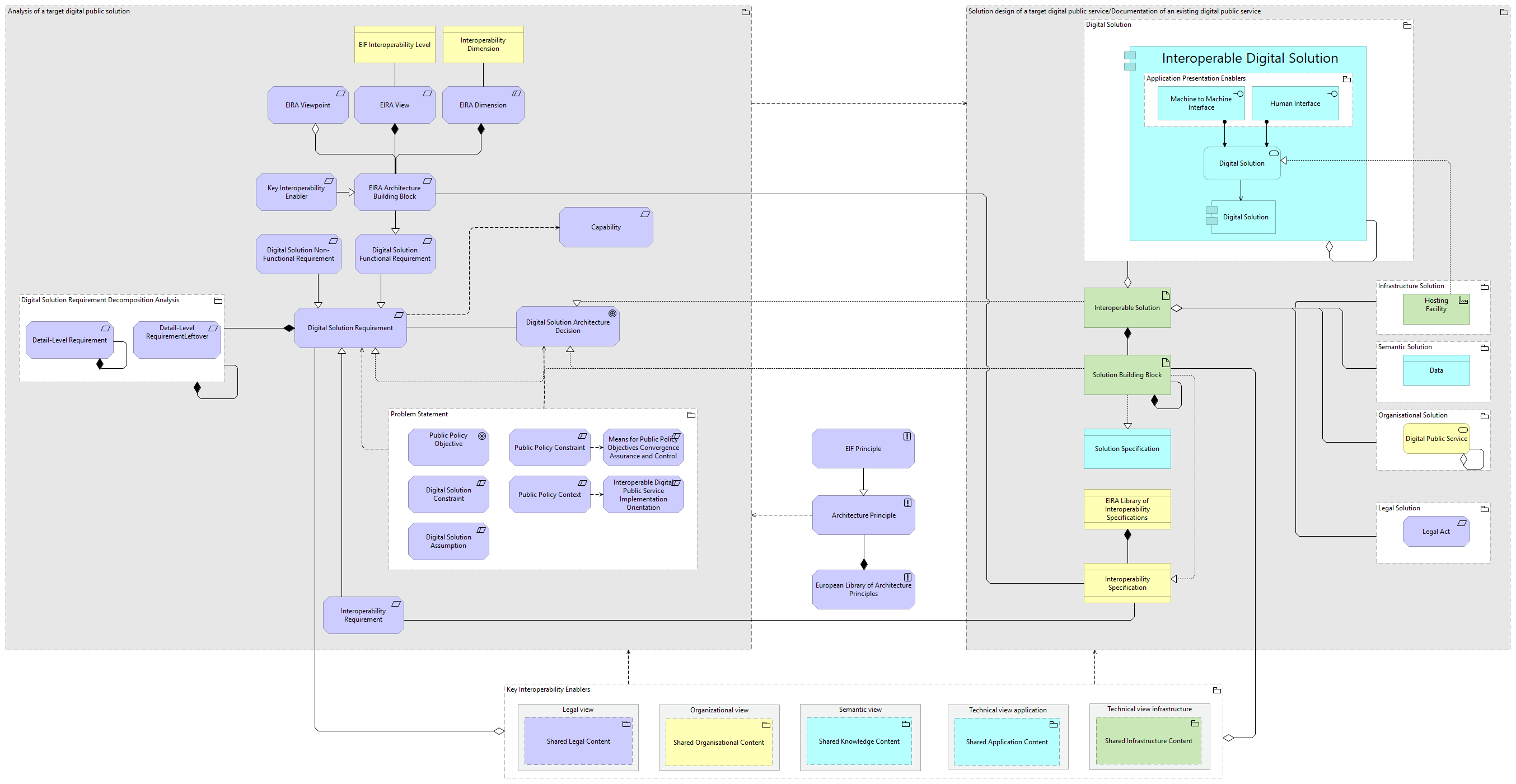
Figure 1 EIRA Ontology View
This ontological foundation is essential for maintaining EIRA as a coherent, well-defined architecture rather than an ad hoc collection of concepts. It establishes the “grammar” and “vocabulary” that govern how EIRA expresses architectural knowledge, ensuring that new ABBs, viewpoints, or other architectural elements can be added systematically whilst preserving the architecture’s overall integrity and consistency.
The Ontology view, as mentioned, introduce the most basic and fundamental concepts and relationships between them. To do so, the view is organised in two main purposes or aspects: 1) the analysis of a European public administration Interoperable Solution, or; 2) the design or documentation of a European public administration Interoperable Solution. It important to mention, as the analysis related content is at higher level, and is focused on explaining and depicting how ABBs are related to the definition of requirements (ABBs are requirements), and the definition of these concepts and all related ones, are key, as they influence and guide the design and documentation of digital public solutions.
2.8.2. Analysis of an European public administration Interoperable Solution
The analysis phase in the EIRA Ontology View defines the conceptual elements used to analyse a target digital public solution and to structure the identification of its requirements prior to design. It captures why a solution is needed, under which constraints, and which interoperability concerns must be addressed, independently of any concrete implementation decisions. The analysis phase establishes a structured problem space that guides and constrains the subsequent design phase.
More specifically, the analysis phase models how public policy objectives, constraints, assumptions, and context are translated into digital solution requirements, including functional, non-functional, and interoperability requirements. These requirements are derived using EIRA views, viewpoints, and dimensions, supported by key interoperability enablers and architecture building blocks. The resulting set of digital solution requirements provides the basis for architectural decisions taken during the design phase.
2.8.3. Design of a European public administration Interoperable Solution or Documentation of a existing European public administration Interoperable Solution
The design and documentation phase in the EIRA Ontology View defines the conceptual elements used to specify, structure, and document an interoperable digital solution based on the outcomes of the analysis phase. It captures how the identified requirements are realised through solution building blocks and specifications, while maintaining traceability to interoperability concerns and policy drivers established earlier.
In this phase, an interoperable digital solution is modelled as a composition of solution building blocks, including application presentation enablers, semantic, organisational, legal, and infrastructure solutions. These elements are described and constrained through solution specifications and interoperability specifications, which may be selected or reused from the EIRA Library of Interoperability Specifications. The resulting documentation supports both the design of new digital public services and the documentation of existing ones in a consistent and reusable manner.
2.9. Key Interoperability Enablers (viewpoint)
The Key Interoperability Enablers Viewpoint provides a focused perspective on the Architecture Building Blocks that are most critical for achieving interoperability in digital public services. Rather than presenting the complete architectural landscape as other viewpoints do, this viewpoint highlights those specific building blocks whose presence and proper implementation are essential conditions for enabling effective interoperable operation across organisational and jurisdictional boundaries.
2.9.1. Purpose and Nature
The Key Interoperability Enablers Viewpoint addresses a fundamental challenge that architects and decision-makers face when working with comprehensive reference architectures: distinguishing between components that are merely relevant and those that are truly critical for achieving interoperability. Whilst EIRA encompasses a broad range of Architecture Building Blocks addressing various aspects of digital public service design, not all ABBs carry equal weight in determining whether a service will be interoperable. The Key Interoperability Enablers Viewpoint identifies and presents those ABBs that function as foundational prerequisites—the components whose absence or inadequate implementation would fundamentally compromise interoperability regardless of how well other architectural aspects are addressed.
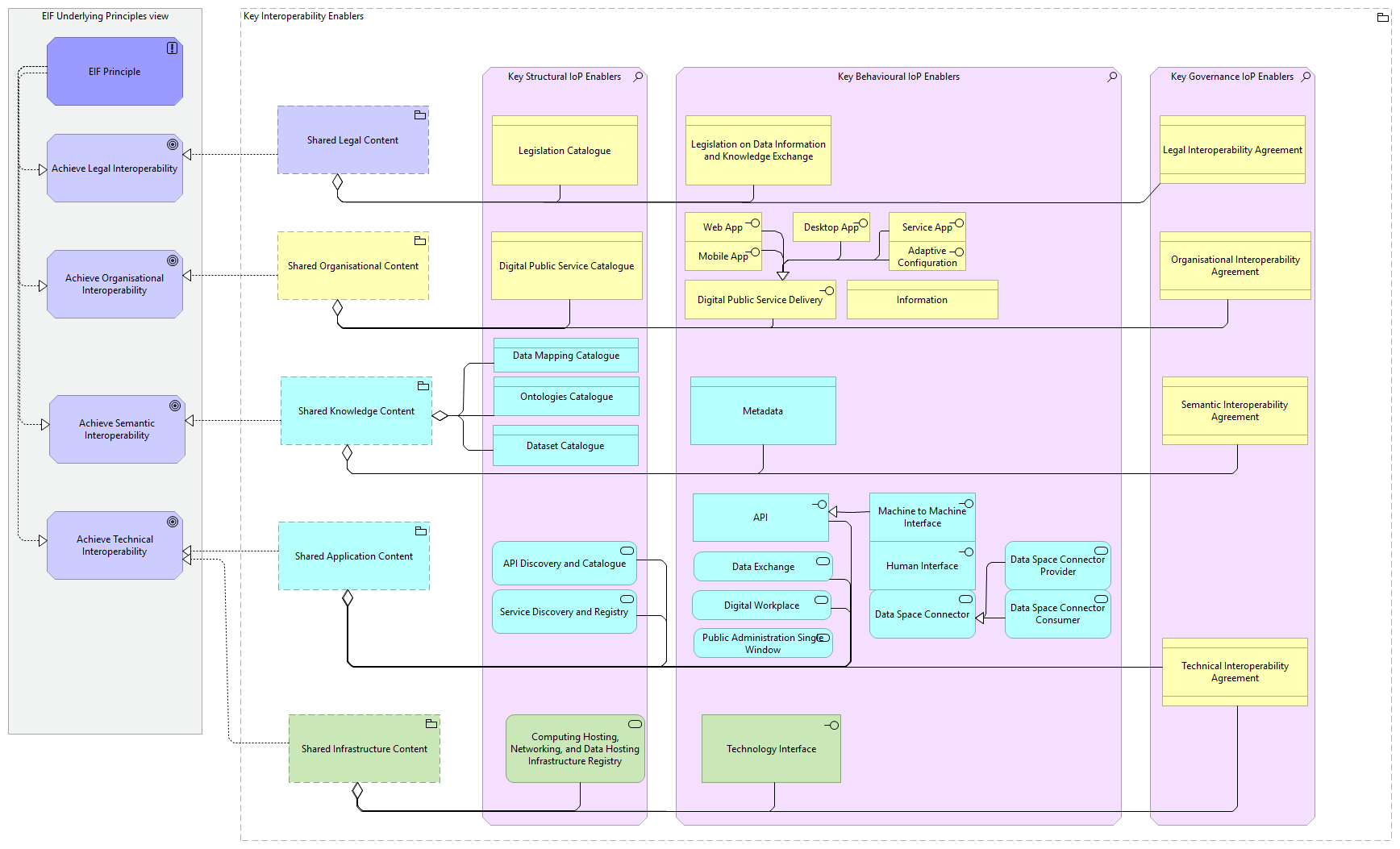
Figure 2 Key Interoperability Enablers
This viewpoint organises key interoperability enablers according to the three interoperability dimensions: Structural, Behavioural, and Governance. Structural enablers address the compositional aspects of interoperable solutions, focusing on how components are organised and shared. Behavioural enablers address the dynamic aspects of interoperability, focusing on how information and knowledge are exchanged. Governance enablers address the collaborative and policy aspects, focusing on the agreements and frameworks that support peer-to-peer coordination. By organising enablers across these dimensions, the viewpoint ensures comprehensive coverage of interoperability concerns whilst maintaining analytical clarity about the nature of each enabler’s contribution.
2.10. The RA and related standards and specifications (ArchiMate©, PAAF)
This Reference Architecture developed by the European Commission to support public administrations on achieving interoperability, and to do so, the RA is tidily related several standards, specifications, and frameworks widely adopted for the development of Enterprise Architectures and Solution Architectures. These are:
2.10.1. ArchiMate© and the RA
The EIRA© is based on and uses ArchiMate© as the core modelling notation and language. It is key as ArchiMate© is a standardised architecture modelling notation and language developed and maintained by The Open Group.
As an international standard, ArchiMate® ensures wide acceptance and provides comprehensive coverage of all architecture domains required by EIRA©, from business and application layers to technology and infrastructure components.
As an example of the alignment and extension of EIRA© vs ArchiMate©, the table below shows the mapping between the EIRA© views and ArchiMate© layers, evidencing the total coverage and alignment:
EIRA© view |
ArchiMate© alignment |
|---|---|
Legal view |
Uses ArchiMate® elements to model governance, compliance, and legal constraints |
Organisational view |
Maps to ArchiMate® Business Layer (business capabilities, processes, actors) |
Semantic view |
Leverages ArchiMate® Data/Information concepts to model data representations, metadata, and semantic agreements |
Technical Application and Infrastructure views |
Maps to ArchiMate® Application and Technology Layers |
Furthermore, the machine-readability of ArchiMate® models, which can be exported in XML format, enables automated processing, validation, and integration with other systems, supporting EIRA©’s goals of promoting reusability and interoperability.
Lastly, ArchiMate®’s extensibility allows EIRA© to customise and specialise building blocks for specific eGovernment contexts while maintaining compliance with core standards, ensuring that solutions remain interoperable and reusable across different Member States and policy domains. The combination of standardisation, completeness, tooling support, and flexibility makes ArchiMate® a solid foundation for EIRA©’s mission to enable seamless digital public services across the European Union.
2.10.2. PAAF and the RA
The Public Administration Architecture Framework (PAAF), developed by the Public Governance Institute of KU Leuven, is a comprehensive Enterprise Architecture framework designed to model complete public administrations. Using ArchiMate© as its modelling language, PAAF enables enterprise architects to represent the entire organisational landscape—from high-level strategic goals, legal compliance, and policy objectives down to operational capabilities and service delivery mechanisms. Critically, PAAF accommodates both digital and non-digital (manual) processes, making it suitable for capturing the full complexity of public sector organisations where traditional and modern service delivery methods coexist.
PAAF and EIRA share a complementary relationship where PAAF operates at the enterprise architecture level with a broad organisational perspective, while EIRA© focuses specifically on solution architecture for interoperable digital public services within the EU context. Both frameworks use ArchiMate©, enabling natural alignment across eleven primary architectural elements—including stakeholders, strategic goals, requirements, principles, capabilities, and digital public services—though with different levels of granularity. The relationship can be understood as PAAF providing the “whole organisation” view while EIRA offers a specialised “zoom-in” on digital public services interoperability, making EIRA effectively a focused subset within PAAF’s broader organizational scope, with the important distinction that EIRA exclusively addresses digital capabilities while PAAF encompasses the entire spectrum of service delivery.
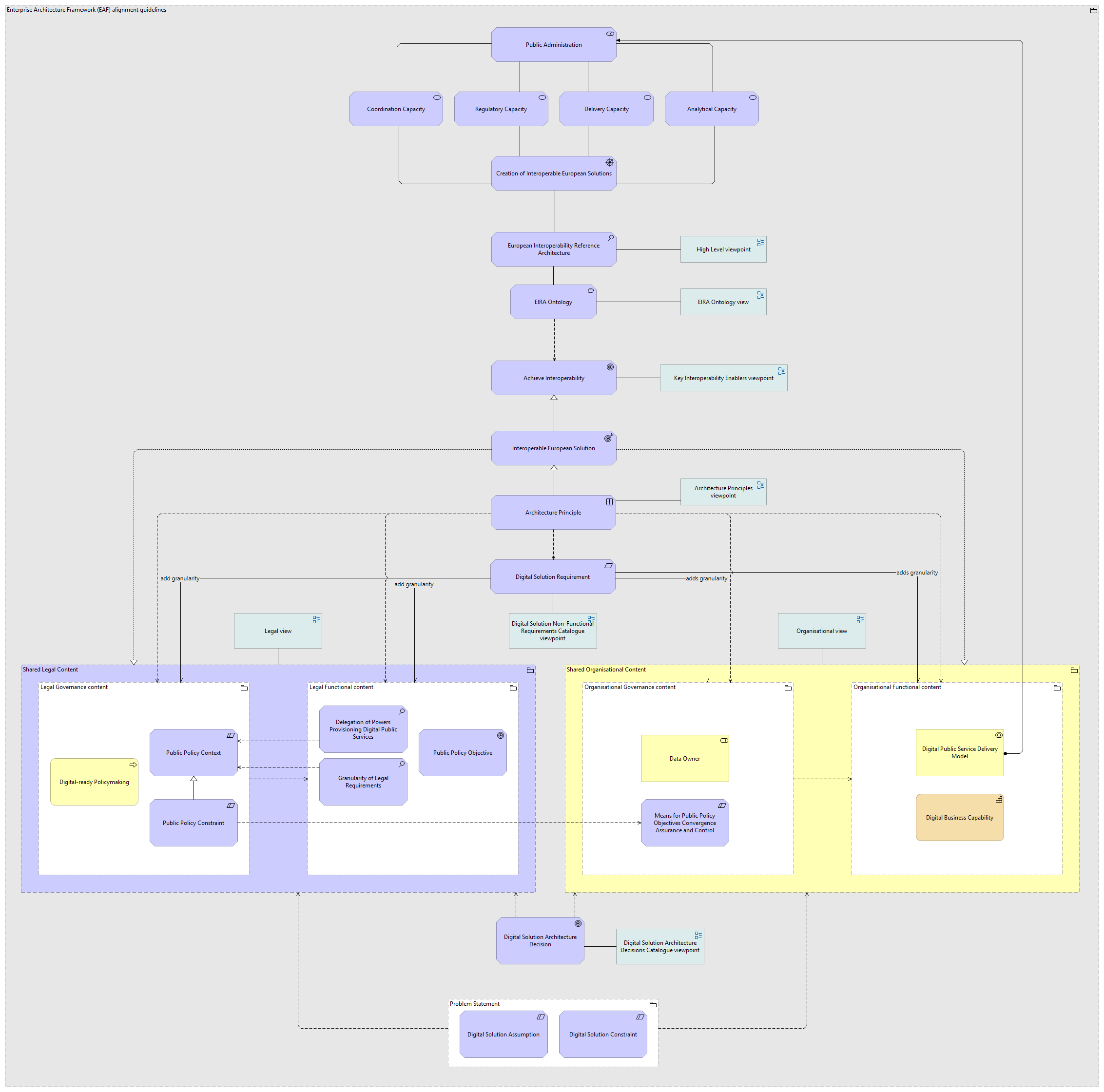
Figure 3 Alignment between PAAF and EIRA
The strategic alignment between PAAF and EIRA bridges the critical gap between enterprise-level strategic planning and solution-level implementation of interoperable digital services, delivering value in both directions. For PAAF users, the alignment provides a clear methodology to translate organisational strategies and public value objectives into concrete, interoperable digital service designs using EIRA’s European interoperability framework. For EIRA users, it offers essential organizational context, ensuring digital solutions support broader public policies and contribute meaningfully to the organisation’s mission across coordination, regulatory, delivery, and analytical capacities. This bidirectional alignment enables improved architectural coherence, enhanced traceability from policy to implementation, and reduced fragmentation, ultimately empowering public administrations to pursue digital transformation systematically while maintaining both organisational strategic alignment and European interoperability compliance.